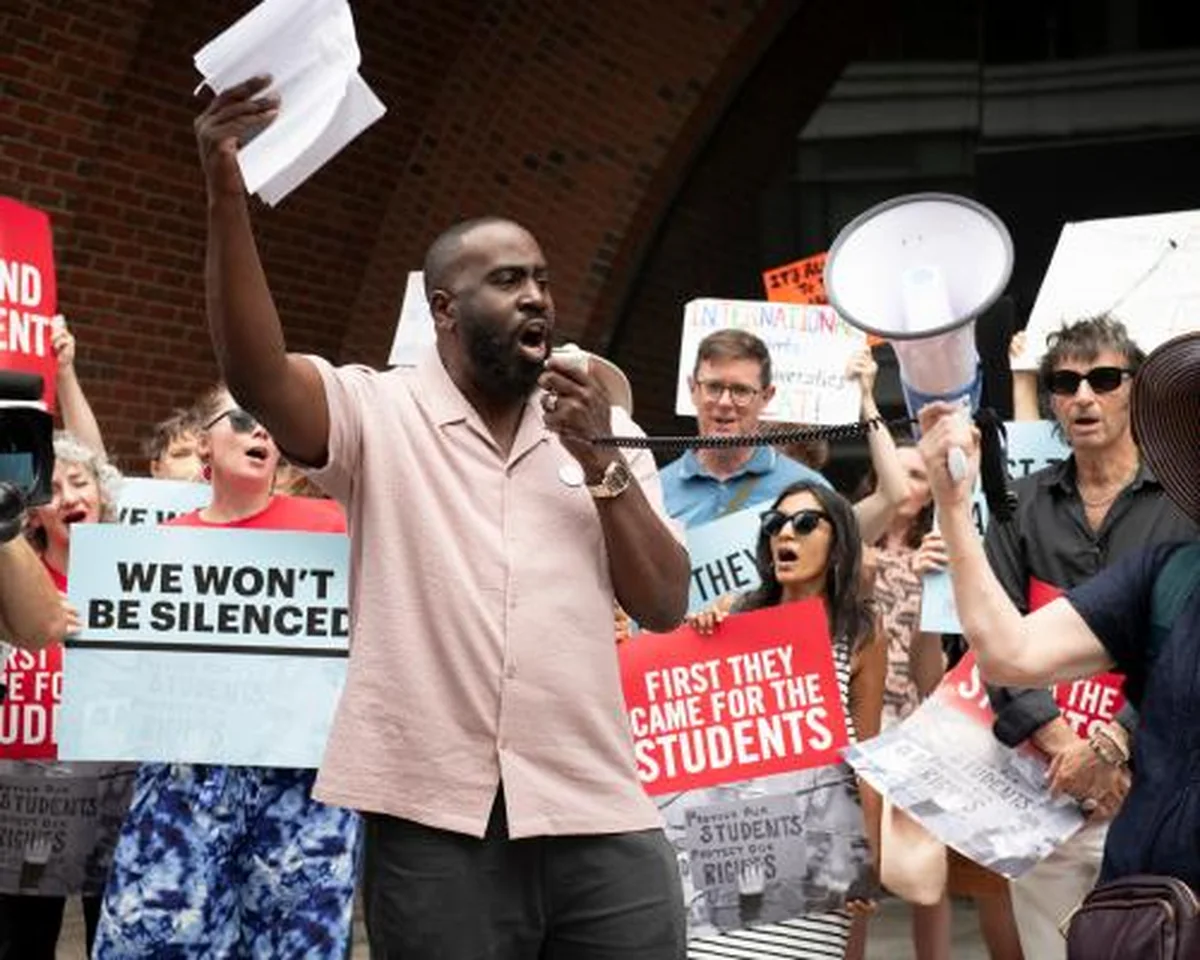
Federal Judge Invalidates Trump’s Free Speech Policy
A federal judge has delivered a scathing indictment of the Trump administration’s directive to detain and deport foreign academics based on their pro-Palestinian sentiments, declaring the policy an unconstitutional infringement designed to “intentionally” suppress free expression.
The landmark decision stems from a lawsuit filed by prominent academic organizations, including the national American Association of University Professors (AAUP), its chapters at Harvard, Rutgers, and New York University, alongside the Middle East Studies Association (MESA). These groups initiated legal action after several non-citizen students and scholars, vocal in their support for Palestinian rights, faced arrest and detention under the controversial policy.
Court Upholds Non-Citizen Free Speech
In a comprehensive 161-page ruling issued on Tuesday, U.S. District Judge William G. Young, a Ronald Reagan appointee, underscored the profound significance of the case. Young characterized the proceedings as “perhaps the most important ever to fall within the jurisdiction of this district court,” emphasizing its critical implications for constitutional liberties.
Judge Young’s opinion directly addressed a fundamental question: “This case … squarely presents the issue whether non-citizens lawfully present here in United States actually have the same free speech rights as the rest of us.” His answer was unequivocal: “The Court answers this Constitutional question unequivocally ‘yes, they do’.”
He further elaborated, referencing the First Amendment’s powerful directive that Congress “shall make no law” abridging free speech. “‘No law’ means ‘no law’,” Young wrote, clarifying that while no one’s freedom of speech is absolute, “these limits are the same for both citizens and non-citizens alike.” This pronouncement firmly establishes that constitutional protections extend to all individuals legally residing within the nation’s borders, irrespective of citizenship status.
“Ideological-Deportation Policy” Accusations
The plaintiffs had accused the government of operating an illicit “ideological-deportation policy.” This claim emerged after former President Trump signed two executive orders in January, ostensibly aimed at combating antisemitism and targeting non-citizens perceived to “espouse hateful ideology.”
During court proceedings, the government vehemently denied the existence of such a policy, dismissing the plaintiffs’ assertions as products of their “imagination.” Officials maintained that any determinations regarding individuals were made on a rigorous case-by-case basis. Furthermore, the government asserted its authority to deport non-citizens who, despite committing no crimes, were deemed to pose a threat to U.S. foreign policy interests. This broad interpretation of executive power was a central point of contention throughout the trial.
Adding another layer of complexity, government attorneys attempted to prevent the disclosure of internal documents detailing its operational procedures related to the policy. This effort to shield information from public scrutiny raised concerns about transparency and accountability in the administration’s actions against foreign scholars and students.
This ruling marks a significant victory for free speech advocates and underscores the constitutional principle that the First Amendment’s protections are not exclusive to citizens, reaffirming the rights of all individuals lawfully present in the United States to express their views without fear of government retaliation or deportation.
Source: The Guardian