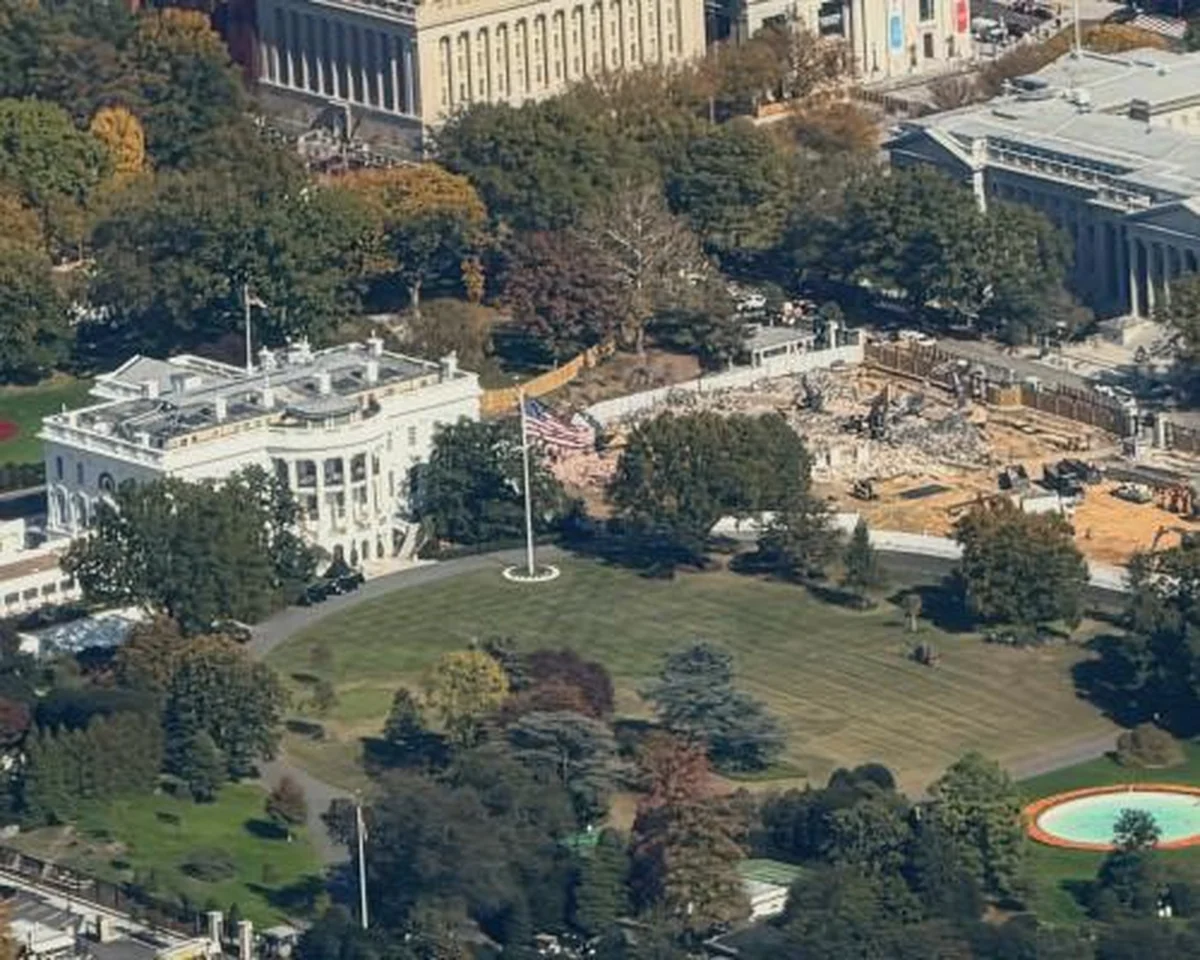
Historic White House East Wing Razed for Trump Ballroom
WASHINGTON D.C. — The White House East Wing, a structure with deep historical roots, has been completely demolished. This dramatic development, confirmed on Friday, follows just days after construction began on a planned $300 million (£225 million) ballroom, a project championed by President Donald Trump for the iconic presidential residence.
The swift razing of the wing represents a stark reversal of President Trump’s earlier assurances. In July, he had pledged that no existing infrastructure of the White House would be torn down to accommodate the new entertaining space. The rapid pace of the project, coupled with circulating images of rubble at the nation’s most famous address, has ignited a wave of strong disapproval among former White House staff and prominent presidential historians. In response, the Trump administration has dismissed these criticisms as “manufactured outrage.”
Understanding the East Wing’s Legacy
For decades, the East Wing served as a vital, albeit often understated, component of the White House complex. Originally known as the East Terrace, it was first constructed in 1902 during Theodore Roosevelt’s presidency. Its form was later significantly expanded and reconfigured by Franklin D. Roosevelt in 1942. This wartime transformation was driven by a dual purpose: to provide crucial additional working space during World War II and, discreetly, to conceal an underground bunker built to protect the president and his staff.
Over time, the East Wing evolved into the operational hub for the First Lady and her dedicated team, becoming synonymous with the social and ceremonial aspects of the presidency. It was also famously home to the Jacqueline Kennedy Garden, a cherished green space. Situated directly across East Executive Avenue from the Treasury Department, the East Wing traditionally functioned as the primary entry point for tourists and guests attending official events, symbolizing the more public and welcoming face of the White House.
A Shift in Plans and Public Outcry
Initial proposals for President Trump’s grand ballroom envisioned the East Wing remaining intact. According to the President’s own statements, it was intended to serve as a sophisticated reception area where guests could mingle, enjoy cocktails, and savor hors d’oeuvres before transitioning into the main ballroom for dinner. However, just days after ground was broken on the ambitious new project, the White House officially confirmed that the entire wing would be dismantled. The demolition process appeared to be fully completed by Friday.
President Trump has frequently voiced his opinion that the existing White House lacks a sufficiently large space for entertaining, often citing the East Room as being too small with a capacity of only around 200 people. The new ballroom is planned to be a sprawling 90,000-square-foot (27,400 square meter) facility. This immense scale means it will significantly dwarf the main White House building, effectively being nearly double its size.
The destruction of a historic section of the White House for a modern addition has sparked a vigorous debate about preservation versus progress, and the appropriate stewardship of national landmarks. As construction continues on the new ballroom, the controversy surrounding the East Wing’s demise is likely to persist.
Source: The Guardian