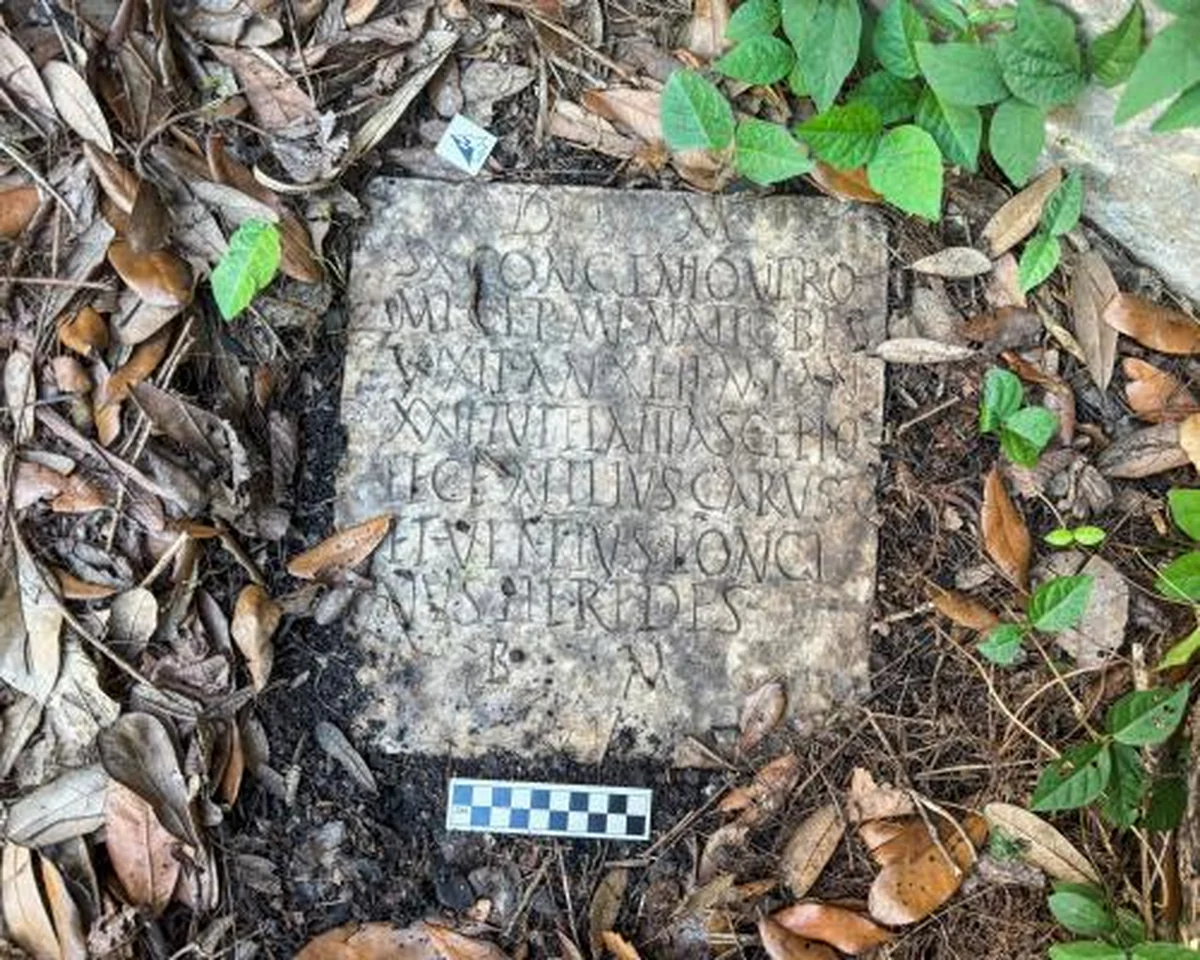
New Orleans Yard Yields 1,900-Year-Old Roman Relic
A surprising discovery in a New Orleans backyard has captivated archaeologists and historians, as a local couple unearthed an ancient Roman grave marker dating back approximately 1,900 years. The remarkable find has initiated an international effort to understand how the relic traveled across continents and to facilitate its return to Italy, its country of origin.
The intriguing artifact came to light in March, when Tulane University anthropologist Daniella Santoro and her husband, Aaron Lorenz, were clearing overgrown vegetation from their property. As detailed in a recent online report by the Preservation Resource Center (PRC) magazine, the couple’s initial observation of an inscription carved into the flat marble slab suggested it was in Latin, the language of ancient Rome. This prompted them to seek expert guidance.
Unraveling the Mystery: Expert Collaboration
Santoro quickly reached out to D. Ryan Gray, an archaeologist at the University of New Orleans, and her Tulane colleague Susann Lusnia, an associate professor specializing in classical studies. The collaborative investigation rapidly gained momentum. Gray, in turn, dispatched photographs of the unusual stone to Professor Harald Stadler at the University of Innsbruck, who then shared them with his brother, a Latin instructor, for linguistic analysis.
Independently, Lusnia and Stadler arrived at the same astonishing conclusion: the headstone was a funerary monument dedicated to a Roman sailor named Sextus Congenius Verus, believed to have lived around the second century AD. Further research by Gray revealed that the stone matched the description of an artifact reported missing from the city museum of Civitavecchia, Italy, a coastal city where the grave marker was originally discovered. This crucial link solidified the artifact’s provenance and its historical significance.
Path to Repatriation
With the grave marker’s identity confirmed, the focus shifted to its repatriation. Lusnia promptly contacted the Civitavecchia museum, initiating the formal process for its return. As a critical step in this endeavor, Santoro and her collaborators, affectionately dubbed her “team tombstone,” formally transferred custody of the ancient stone to the FBI’s art crime team. This involvement underscores the international legal and cultural significance of such a find and the commitment to returning cultural heritage to its rightful place.
The “team tombstone” also embarked on a parallel investigation: piecing together the unlikely journey of Sextus Congenius Verus’s memorial from ancient Italy to a modern New Orleans garden. According to Gray’s column for the PRC, a non-profit organization dedicated to preserving New Orleans’s architectural legacy, preliminary theories suggest the tombstone likely arrived in the Crescent City sometime in the 20th century. One prominent hypothesis posits its transport after World War II, a period when U.S. and Allied forces were extensively deployed in Italy, potentially facilitating the movement of such artifacts.
While the exact circumstances of its transatlantic voyage remain to be fully uncovered, the discovery serves as a powerful reminder of the enduring connections between distant cultures and epochs. The New Orleans couple’s backyard find has not only brought a piece of Roman history to light but also fostered a unique partnership aimed at honoring its past and ensuring its future.
Source: The Guardian